
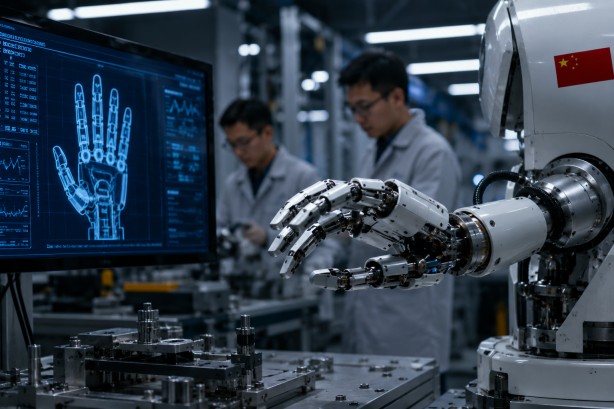
Chinese robotics firms are accelerating the development of advanced robotic hands, tackling one of the most complex hurdles in creating humanoid robots. These companies are leveraging artificial intelligence alongside China’s robust manufacturing strengths to design hands capable of intricate tasks like object manipulation, tool use, and daily activities. Such advancements are pivotal in making humanoid robots viable for domestic, healthcare, and industrial applications.
The challenge of replicating the human hand’s dexterity and precision is acknowledged as more daunting than constructing other parts of humanoid robots. Developers face both hardware issues, such as designing compact motors and sensors, and software hurdles that involve programming robots to interpret touch, pressure, and execute complex movements.
China has solidified its position as a leader in the global robotics industry, thanks to its sophisticated supply chain and government-backed initiatives focusing on “embodied AI.” The nation’s flourishing robotics sector is fostering swift innovation, with enterprises working on robotic hands, wearable sensor gloves, and AI systems that learn from human movements through real-world data.
Experts suggest that enhancing the dexterity of robotic hands is crucial for developing robots capable of performing a variety of tasks, ranging from household chores to industrial functions and even advanced prosthetic uses. This technological leap is expected to bring humanoid robots closer to practical deployment in diverse settings.
Industry leaders anticipate that ongoing progress in AI and robotics will eventually facilitate humanoid robots operating seamlessly alongside humans, unlocking new possibilities across sectors like manufacturing, healthcare, and consumer services.